It is not only speed
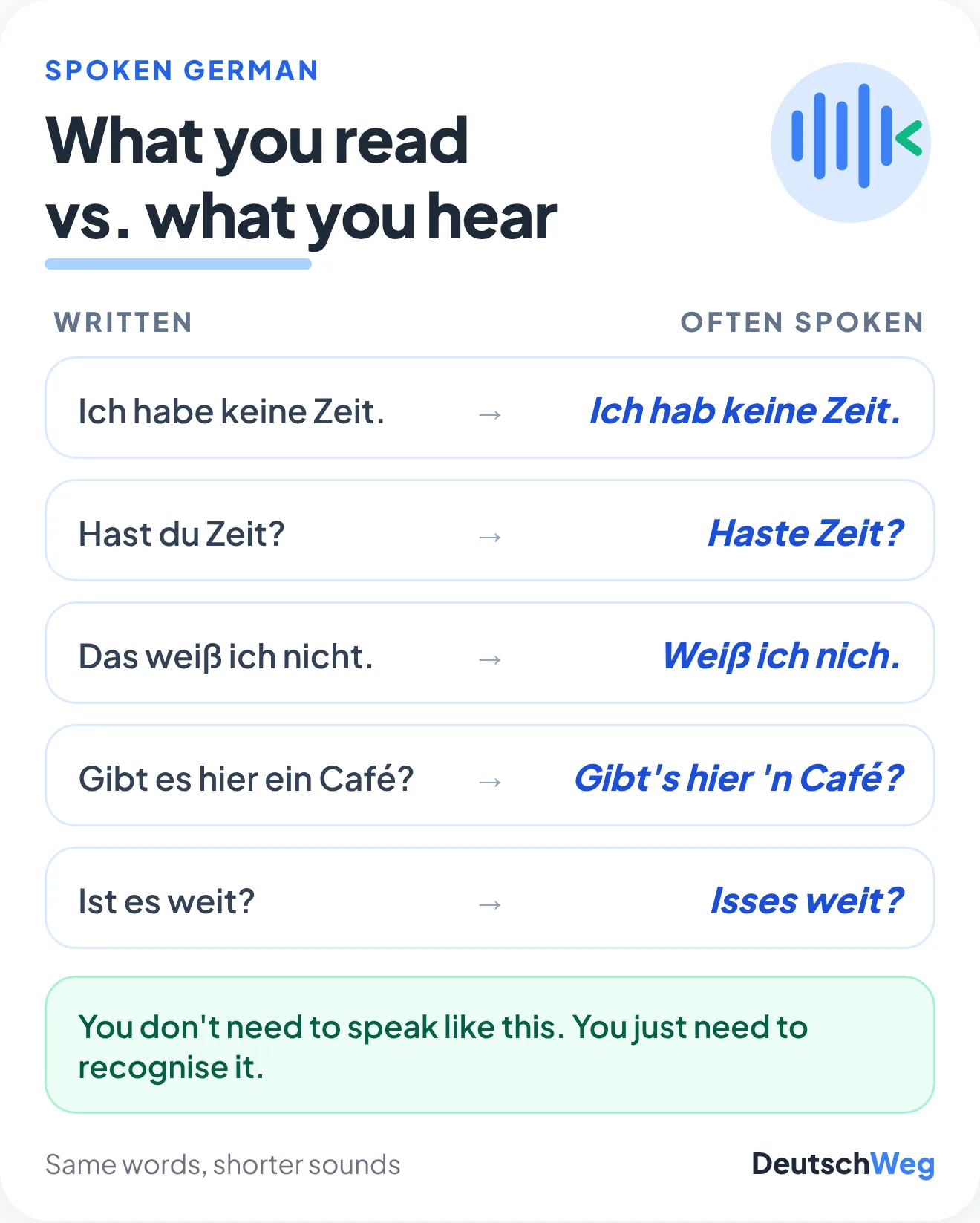
Native speakers do talk quickly, but speed is only part of the problem. In everyday speech, words are shortened and joined together. You learned „Hast du Zeit?“. What you hear is often „Haste Zeit?“. Your brain is looking for three words and hears two sounds.
At the same time, you are still translating in your head. While you work out the first sentence, the second one has already gone past.
The short forms you will hear most
These are normal in everyday German. You do not need to use them yourself, especially not in an exam. But if you know them, you will suddenly recognise words you already know.
- ich habe → ich hab
- hast du → haste
- nicht → nich
- gibt es → gibt’s, ein / einen → ’n / ’nen
- ist es → isses
Listen for the important words
You do not need every word. In most everyday situations, three or four words carry the message: a time, a place, a number, a yes or no.
Before you listen, ask yourself: What do I need to know? At a station announcement, that is the platform and the time. At the doctor's reception, it is the day and the time of your appointment. Listen for those words and let the rest go.
A 10-minute listening routine
- Listen once without reading (2 minutes). Choose one short recording. Only ask: what is the situation, and what is the main point?
- Listen again with the questions (3 minutes). Now look for the important words: times, places, numbers.
- Read the transcript (3 minutes). Find the places where you got lost. Often it is a short form or two words joined together.
- Listen one last time (2 minutes). Now you hear what you missed before. That moment is real progress.
Use the same short recording several days in a row rather than a new one every day. Your ear learns from repetition.
Say it out loud
Listening and speaking help each other. Pause the recording after one sentence and repeat it, at the same speed if you can. This is called shadowing. Your mouth learns the rhythm, and afterwards your ear recognises it more easily.
In real conversations, you are allowed to ask
People in Germany are used to learners. These sentences are polite and normal:
- „Entschuldigung, können Sie bitte langsamer sprechen?“
- „Können Sie das bitte wiederholen?“
- „Meinen Sie Dienstag oder Donnerstag?“ — repeat the part you are unsure about.
Your first step today
Do one short listening exercise with the 10-minute routine above. Listen first without reading, then with the questions, then with the transcript.
Tomorrow, do the same exercise again. If it already sounds slower, your ear is learning.
Practise for this step
Try the 10-minute routine with a free A1 listening exercise Free · no account Start →More practice