Why reading feels easy and speaking does not
Reading and speaking use German in different ways. When you read, the words are in front of you. You recognise them, at your own speed. When you speak, you have to find the words yourself, put them in order and say them, while someone is waiting and while you are listening at the same time.
Nerves make this harder. When you feel watched, it is more difficult to think of words you actually know. That is why the answer often comes back a few seconds later.
The good news: at A1 you do not need to invent much. You can prepare most of what you will say.
At A1, the speaking tasks are predictable
In the Goethe A1 exam, speaking has three short tasks: you introduce yourself, you ask and answer simple questions about everyday topics, and you ask someone for something. The same kinds of questions come up in daily life, too: at the doctor's, at work, at your child's school.
So instead of hoping the right words appear, you can prepare them. Read more in what each part of the A1 exam tests.
Step 1: write your answers once
Write seven short sentences about yourself. Simple is better than impressive:
- Ich heiße Grace.
- Ich bin 28 Jahre alt.
- Ich komme aus Kenia.
- Ich wohne in Nairobi.
- Ich spreche Englisch, Swahili und ein bisschen Deutsch.
- Ich arbeite als Krankenpflegerin. (I work as a nurse.)
- Mein Hobby ist Kochen.
Use your own details. These are the sentences you will say most often in German, in the exam and outside it.
Step 2: say them out loud, three times
Writing is not enough. Your mouth needs practice too.
- First time: read the sentences aloud, slowly.
- Second time: look away and say them from memory. It is fine to check.
- Third time: say them as if someone asked you, at normal speed. Record a voice message and listen once.
Most people notice that the third time already feels easier than the first. That is the feeling you want to build.
Step 3: practise the question you did not expect
In the second task you get a topic and a word, and you make a question. For example, the topic Essen and the word Frühstück:
„Was essen Sie zum Frühstück?“ (What do you eat for breakfast?) and an answer: „Ich esse Brot und trinke Kaffee.“
Practise with question words: Was, Wo, Wann, Wie, Woher. One question a day is enough to make this feel normal.
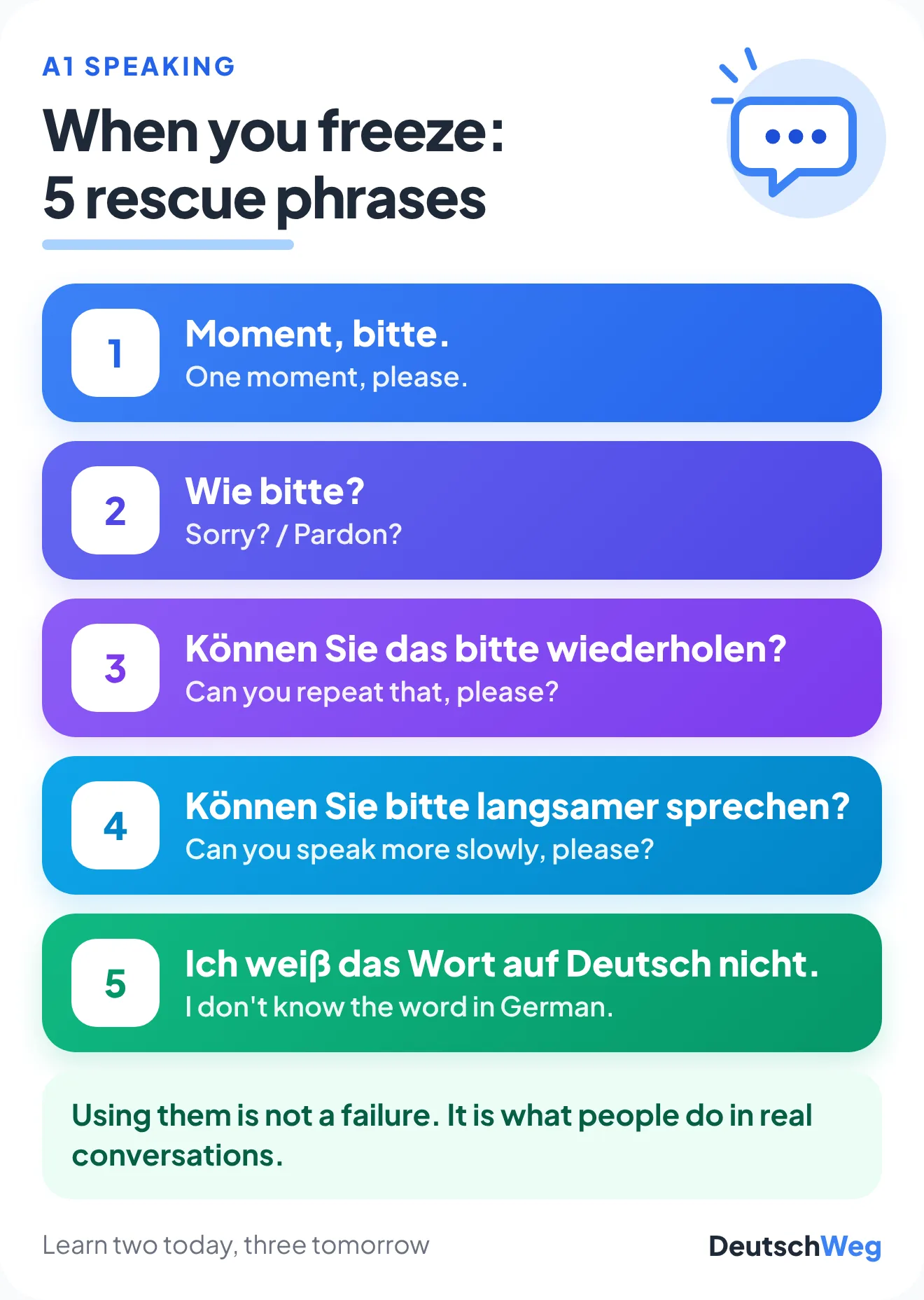
Five phrases for the moment you freeze
Learn these by heart. They give you time and keep the conversation going, and they are correct, polite German:
- „Moment, bitte.“ (One moment, please.)
- „Wie bitte?“ (Sorry? / Pardon?)
- „Können Sie das bitte wiederholen?“ (Can you repeat that, please?)
- „Können Sie bitte langsamer sprechen?“ (Can you speak more slowly, please?)
- „Ich weiß das Wort auf Deutsch nicht.“ (I don't know the word in German.)
Using them is not a failure. It is exactly what people do in real conversations.
Your 10 minutes today
- 4 minutes: write your seven sentences.
- 4 minutes: say them out loud three times, the last time without looking.
- 2 minutes: learn two of the five phrases above.
Then notice what changed: today you said seven German sentences without reading them. Tomorrow, practise one question with a word card.
Practise for this step
Prepare your answers for the three A1 speaking tasks Free · no account Start →More practice