How the B1 speaking exam works
You usually take the speaking exam together with another candidate. Only in exceptional cases do you take it alone. The exam lasts about 15 minutes for the two of you. Before it starts, you get 15 minutes to prepare alone. You may write notes, but in the exam you should speak freely. Dictionaries and phones are not allowed.
- Teil 1, about 3 minutes: plan something together with your partner.
- Teil 2, about 3 minutes: present a topic. You choose one of two topics.
- Teil 3, about 2 minutes: talk about the presentations: react to feedback and questions, then give your partner feedback and ask one question.
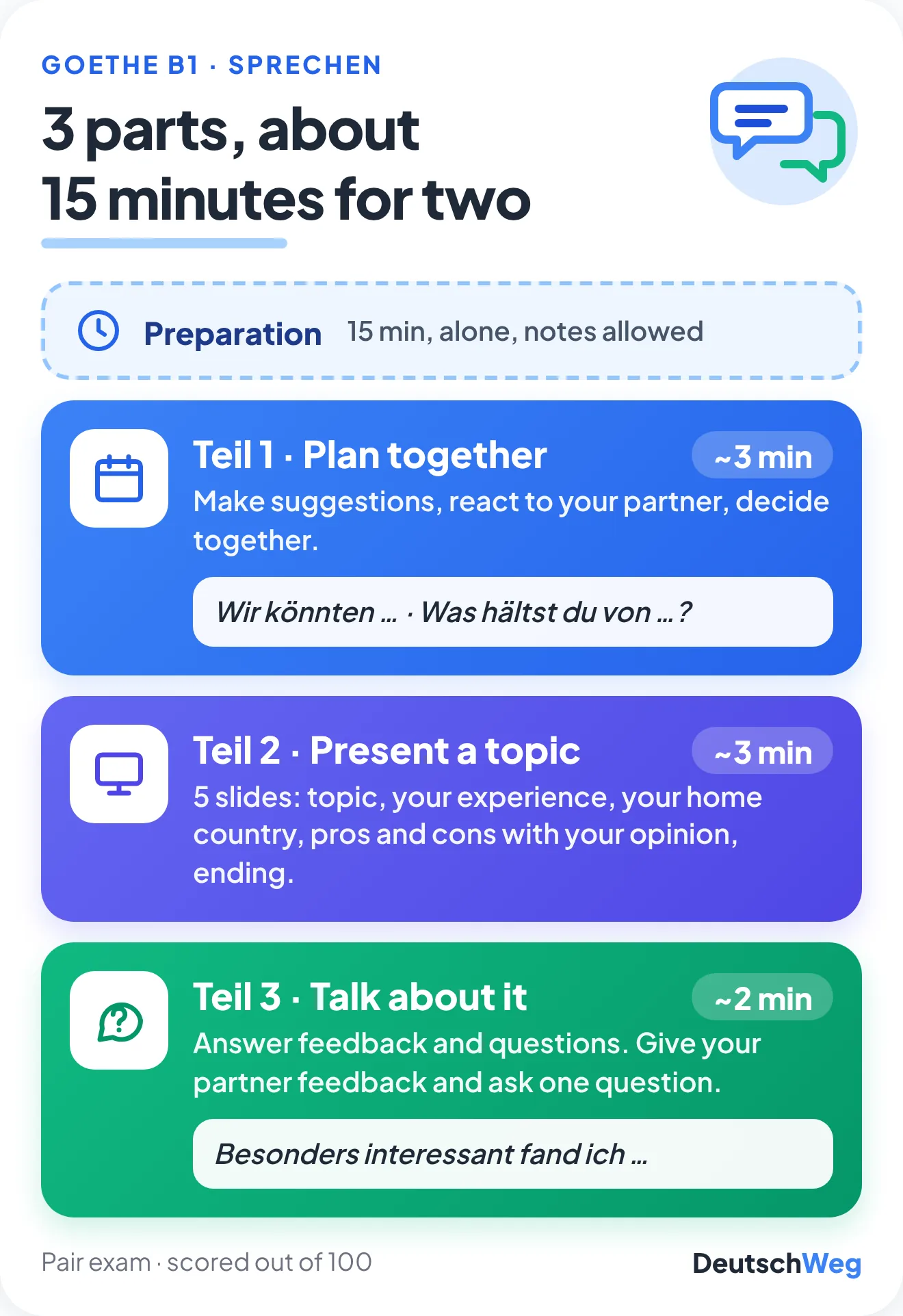
Teil 1: Plan something together
You and your partner get a situation, for example organising a trip or a small party, with a few questions to cover: when, where, how to get there, what to bring. The task is not to give a speech. It is to make suggestions, react to each other and decide together.
- Suggest: „Wir könnten am Samstag fahren.“ / „Ich schlage vor, dass wir …“
- Ask your partner: „Was hältst du von …?“
- Agree: „Das ist eine gute Idee.“ Disagree politely: „Ich bin nicht sicher, ob das klappt, weil …“
- Decide: „Dann machen wir es so: …“
Talk about every point on the task sheet. A quick decision on each point is better than a long discussion of only one.
Teil 2: Present a topic in 5 slides
You choose one of two topics. The task sheet shows five slides, and each slide tells you what to talk about. Your job is to fill them, one after the other, in about three minutes.
- Introduce the topic and how your talk is structured. „Ich möchte heute über das Thema ‚Online einkaufen‘ sprechen. Zuerst …, danach …“
- Your own situation or an experience. „Ich selbst kaufe fast jede Woche online ein. Letzten Monat …“
- The situation in your home country, with examples. „In Kenia ist das anders. Dort …, zum Beispiel …“
- Pros and cons, and your opinion. „Einerseits spart man Zeit, andererseits … Meiner Meinung nach …“
- End and thank your listeners. „Damit bin ich am Ende. Vielen Dank für Ihre Aufmerksamkeit!“
Slides 2 and 3 are where you can use your own life, and they are the easiest to prepare in advance for any topic.
Teil 3: Feedback and one question
Teil 3 follows the presentations. After yours, your partner and the examiner give you feedback and ask questions, and you answer. After your partner's presentation, it is your turn: give short feedback and ask one question.
- Feedback: „Vielen Dank. Besonders interessant fand ich …“
- A question: „Du hast gesagt, dass … Kannst du das genauer erklären?“
- Answering: „Danke für die Frage. Also, ich glaube, …“
- If you did not understand: „Könntest du die Frage bitte wiederholen?“
Listen to your partner's presentation with a pen in your hand. Write down one point you found interesting. That one note gives you both your feedback and your question.
How it is marked
The speaking module is scored out of 100 points, and you pass it with at least 60. The official assessment looks at whether you completed the task, how you interact, how well your ideas connect, your vocabulary, your grammar and your pronunciation.
Notice that interaction is one of the criteria. In Teil 1 and Teil 3, reacting to your partner counts, not only what you say yourself.
Use your 15 minutes of preparation well
- Choose your Teil 2 topic quickly. Pick the one where you have a personal story for slide 2.
- Write keywords for each slide, not full sentences. In the exam you should speak freely, not read out a text.
- Write your first and last sentence in full. A clear start and end calms you down.
- Look at the Teil 1 points and note one suggestion for each.
Your first step today
Pick any everyday topic, for example public transport, working from home or cooking. Set a timer for three minutes and present it out loud, slide by slide, using the five steps above. Record yourself on your phone.
Listen back once. If you got through all five slides, you already know the structure of Teil 2.
Practise for this step
B1 Sprechen Strategie: all 3 parts, phrases and example answers B1 level · paid See what’s inside →Keep reading
Sources
- Goethe-Institut – Goethe-Zertifikat B1, Übungssatz Erwachsene (Sprechen)
- Goethe-Institut – Durchführungsbestimmungen Goethe-Zertifikat B1 (Stand 1. September 2025)
Last checked: November 2026
Exam rules and formats can change. Please check the current details with the Goethe-Institut or your exam centre.